Friday, August 12, 2016

Heat stress in trees


We have had a pretty hot and dry summer throughout much of South Carolina and, although we are seeing some precipitation now, many trees are showing signs of stress.

Heat, especially combined with drought conditions, can damage trees in several ways. Most trees grow best in the 75°F to 85°F (24-30°C) temperature range. Above about 95°F (35°C) photosynthesis becomes less efficient, using more energy than it creates. Most plants cannot survive temperatures above 112°F (44°C). At these temperatures enzymes denature, nucleic acids (DNA and RNA) unravel, and cellular function ceases. Trees can cool down, most efficiently by transpiration, but this requires water, lots of water! When temperatures stay high for multiple days, trees feel it!

Trees respond differently to excessive heat and drought. Some species, like many pines, tulip poplar and sycamore, will drop older foliage to reduce transpiration loads and water loss. Others, like maples and many oaks, keep their foliage on but are thrifty with available water so that many leaves get a scorched appearance, usually around the edges of the leaves. Most of these trees will look poorly, but should recover once water is available and temperatures have cooled down.

Water is key to helping trees survive and is most effective BEFORE the trees are stressed. When weather is hot trees need more water. Watering in the heat of the day can be wasteful… much of the water is lost to evaporation so it is better to water in the evening. Avoid watering at the base of the tree; many of the roots that absorb water and nutrients are at or beyond the drip line, the ground with foliage directly overhead. Applying fertilizers can be counterproductive; stimulating new growth will increase the water requirements of the tree.

Trees are resilient. With a little extra care and the right weather, stressed trees should come out healthy next spring!
Maple leaves showing the scorched symptoms typical of draught or heat stress. Some fungal diseases cause similar symptoms, but usually when it is cooler and wetter.

These oaks are showing signs of stress from the long (more than one week) exposure to temperatures at or close to 100 degrees.

Tuesday, June 28, 2016

What city trees and their pests can tell us about climate change


Planting trees in cities is a great thing!  Trees regulate temperatures, filter air, and reduce runoff. And a tree-lined cityscape is beautiful!

But anyone who works as a tree health specialist knows that if you want to find a sick tree, go to the city. Many urban trees are plagued with a number of insults: reduced space for roots, pollution and other factors can reduce the growth and vigor of trees. What about higher temperatures?

Cities are known to be “heat islands” and can be several degrees warmer than surrounding rural environments, especially at night. This is a result of heat produced by dense motor traffic and the concrete and asphalt re-radiating the sun’s heat. If there is inadequate water heat can be devastating to trees. The stomates, minute holes in leaves that allow for gas exchange, stay open to evaporate water and cool the tree down, but this requires water. If there is no water, the plant begins to wilt.

It appears that heat can affect tree health in more subtle and indirect ways.

Recent work from the lab of Dr. Steven Frank at North Carolina State University has shown that scale pests of some urban trees are more abundant on trees in hotter parts of the city and that these insects have a negative impact on the infested tree’s health.

Red maples and willow oaks are popular trees in the urban landscape. Look closely at specimens of these trees in cities and you are likely to find scale insects: gloomy scale (Melanaspis tenebricosa) on maple, and oak lecanium (Parthenolecanium quercifex) on oaks. You would be hard-pressed to find these scale insects on their hosts during a walk in the woods. The leafless limbs on many maples and willow oaks planted in parking lots are often a result of these pests.

Oak lecanium scales on willow oak.
Gloomy scale on the bark of a maple.
 
Why are they more common on urban specimens? Stressed trees are often more susceptible to pests. They are too busy trying to survive and allocate fewer resources to defending themselves. But this is not true for sap-sucking insects like scales and aphids which are often more common on the healthiest plants. Greenhouse experiments showed that increased temperature, not lack of water or fertilizer, was the only measured variable accounting for the increase in scale insects.  

Like all insects, scales are cold-blooded and reproduce faster at higher temperatures (just a note: this is true within an optimum range of temperatures that varies according to the species; above a species’ maximum their survivorship rapidly declines).

But if it was simply a matter of faster reproduction as a result of warmer temperatures we would expect other insect pests to increase on trees in warmer areas, too, but that is not the case. Although willow oaks and red maples have a number of insect pests associated with them, including several other scale insect species, oak lecanium and gloomy scale stand out as pests of oaks and maples in warmer environments.

What does this tell us about the impacts climate change will have on our forests? It tells us that it’s complicated. There will be winners and there will be losers. There are many trees that do very well in urban environments. In fact, oaks and maples are great urban trees if planted in the right place. It tells us that some insects are predisposed to take advantage of warmer environments and these may become considerable pests in warmer environments.


Friday, May 20, 2016

Fire blight


We are noticing a lot of Callery pears (some people call them Bradford pears) with brown and black wilted foliage and stems, an indication that they are infected with fire blight. That’s good news for those of you who don’t like Callery pears, but it could mean trouble for edible pears, quince and apples!
Wilted stems and foliage with scorched appearance characteristic of infection by fire blight.
 

Fire blight is caused by the bacteria Erwinia amylovora and is especially common in warm, wet springs. It attacks a variety of plants in the rose family, particularly pears and quince, though apples, hawthorns, cotoneasters and pyracantha can also be infected. Oddly enough, the Callery pear is supposed to be resistant to fire blight, but it isn’t this year!

The bacteria most often enters through blossoms, transmitted by pollinators, including honey bees, and splashing by rain. It can also enter through wounds. The infected blooms and stems wilt and turn brown, reducing fruit production. The bacteria can be transported through the vascular system. If the disease becomes systemic and reaches the roots the tree can die.

Infected branches can be pruned and destroyed to prevent the bacteria from reaching the vascular tissue in the trunk. However, pruning can stimulate growth of tender tissues which are more susceptible to fire blight. The addition of nitrogen fertilizers should be avoided for the same reason.

If you do decide to prune, cut at least one foot below where the symptoms are visible and make sure your pruning implement is cleaned before/after each pruning cut to avoid transmitting the bacteria to new branches. Pruned material should be removed from the area and destroyed to reduce the risk of re-infection.
To avoid loss of production fruit growers sometimes apply antibiotics, but this must be done PRIOR to infections. In some locations fire blight has shown resistance to commonly used antibiotics and they are no longer effective. Some work has shown that innocuous bacteria or yeasts can outcompete the fire blight bacteria and protect blossoms and stems if applied PRIOR to infection.

Friday, December 18, 2015

Pest Alert: Spotted lanternfly


Be on the lookout for a new exotic insect, the spotted lanternfly (Lycorma delicatula)! Native to Southeast Asia, the spotted lanternfly moved to the Korean peninsula in 2006 where it has become a pests of fruit crops, including grapes, apples and pears, and forest trees. In 2014 a population was discovered in Pennsylvania, but there is evidence that it had been there at least two years prior.

An adult specimen of the spotted lanternfly with its wings spread. Adults are about 1 inch long. Photo credit Lawrence Barringer, Pennsylvania Department of Agriculture, Bugwood.org.

An adult and nymph spotted lanternfly on a tree trunk. Photo credit Lawrence Barringer, Pennsylvania Department of Agriculture, Bugwood.org.

Late-stage nymph of the spotted lanternfly. Photo credit Lawrence Barringer, Pennsylvania Department of Agriculture, Bugwood.org.

Early-stage nymph of the spotted lanternfly. Photo credit Lawrence Barringer, Pennsylvania Department of Agriculture, Bugwood.org.
The spotted lanternfly is a phloem-sucking planthopper. Although it has wings as an adult and can fly it tends to be more of a hopper. Females lay their egg masses on a variety of smooth surfaces, including tree bark, dead wood, outdoor furniture, and vehicles. Currently limited to Pennsylvania, unwitting transport of eggmasses could rapidly expand the range of this insect.

The adults prefer to feed on tree-of-heaven, Ailanthus altissima, which will be good news to native plant lovers, but it also feeds on grape vines and poses a grave threat to grape growers. The nymphs feed on a much wider variety of hosts, including a number of stone and pome fruits, and forest trees including pines, maples, and oaks.

The adults and the nymphs tend to feed nocturnally in groups, so it is best to look for them at dusk or at night. Feeding often results in weeping wounds on the tree bark and the build-up of honeydew and sooty mold at the base of the tree.

The adults and nymphs are striking, which often indicates that an animal is unpalatable. It appears they sequester toxins from the tree-of-heaven that protect them from vertebrate predators, such as birds.

It is too early to say what impact this insect could have on South Carolina’s forests and agriculture if it arrived, but it is better to be prepared. In its native habitat natural enemies and diseases keep populations of the spotted lanternfly below damaging thresholds. In Korea and North America there are no natural enemies and so populations get larger than they normally would.
If you suspect that you have found spotted lanternfly please contact your local extension agent or the South Carolina Forestry Commission at (803) 896-8838 or djenkins@scfc.gov

Friday, November 13, 2015

Cankerworm


I received a call recently about using banding to prevent outbreaks of cankerworm.
A female fall cankerworm. Note that she is wingless and has to crawl up the trunk to lay her eggs. Photo credit: James B. Hanson, USDA Forest Service, Bugwood.org.
Egg mass of fall cankerworm. All of these eggs have hatched. Photo credit: Pennsylvania Department of Conservation and Natural Resources, Forestry Archives, Bugwood.org.
Larvae of fall cankerworm. Photo credit: E. Bradford Walker, Vermont Department of Forests, Parks and Recreation.
 

There are two species of cankerworm; the fall cankerworm (Alsophila pometaria) and the spring cankerworm (Paleacrita vernata). Both of these moths are in the geometer or inch-worm family, Geometridae. Both are very polyphagous, that is, they have wide host ranges, including oak, elm, apple, and beech, among many others. Both species are native to North America. In both species the female is completely wingless and must climb up the tree to lay their eggs. The fall cankerworm does so in November and December and the spring cankerworm does so in spring. The eggs of both species hatch at budbreak and begin to feed on the tender young foliage, leaving just the veins of the leaves.
Defoliation caused by cankerworm. Photo credit: USDA-Forest Service, Ogden ARchives, Bigwood.org.
 
Because the females have to crawl up the trunk to lay their eggs applying a band of sticky substance, such as Tanglefoot™, can completely control infestations on that tree. Banding, as this practice is called, is used by many homeowners and by some cities to keep populations at low levels.
Bands applied to trees to keep female cankerworms from climbing up the trunk to lay their eggs. Photo credit: Keith Douce, University of Georgia, Bugwood.org.
 
Charlotte/Mecklenburg County in North Carolina has had increasing populations of cankerworms, despite aerial pesticide applications. Because the defoliation occurs almost every year many urban trees are weakened and made susceptible to other pests and diseases. These dying urban trees often drop limbs and can cause property damage or injury in urban environments. The caterpillars can become so numerous that they cause allergic reactions in some people. As such, Charlotte has implemented a banding program. The city identifies especially susceptible trees, particularly older, weaker willow oaks, and applies bands to these trees in November and December to keep the female cankerworms from crawling up the tree.

Trees are more resilient than we often give them credit for. Most trees can withstand complete defoliation if they are healthy and if the defoliation is not repeated soon. In these cases preventative action does not need to be taken.

Trees that have been exposed to drought or other stress will likely decline after a defoliation episode and so these need to be protected. If you noticed a large outbreak last spring now (November and December) is the time to act. You can band the tree by wrapping a cotton cloth around the trunk of the tree. This cotton cloth should be at least three feet above the ground and below any limbs. The cloth can be attached with electrical tape. Place a strip of roofer’s felt over cloth, attached with a staple gun on larger trees or electrical tape on smaller trees. Using a rubber glove or a spatula apply a thick layer of Tanglefoot™ to the roofer’s felt. Apply it as if you were icing a cake.

Take care of your trees and they will take care of you!

Wednesday, November 4, 2015

Bark splitting


Many trees have noticeable splits in the bark of their trunks or limbs. There are a number of potential causes.

The outer layer of bark is a dead protective layer. As the trunk grows outward adding a new bark layer the old layer may split or slough off. This is especially noticeable in some trees, like river birches, white oaks and shagbark hickories.
The trunk of a shagbark hickory, Carya ovata.
Tree species with thin bark, including, ornamental cherries, maples, and fruit trees, can be damaged by sunscald or frost cracks. Damage by both sunscald and frost cracks will always be on the side of the tree receiving the most sun… the south or southwest. The temperature of bark receiving sun can change drastically in a short period of time. This causes tissue to shrink and expand and could rupture the bark. Frost cracks are likely to form in previous injuries.

Normal bark splits in a red maple, Acer rubrum.
Usually these splits are harmless and the tree heals itself. However, it can allow decaying fungi or wood-boring insects to enter, especially if it hasn’t healed in the spring and summer when these organisms are active.

Sunscald on the trunk of a peach tree, Prunus persica.
Some activities make trees more prone to bark splitting. Over-pruning limbs can suddenly expose more bark to the sun without giving the tree time to adapt. It is better to gradually prune any unwanted limbs, if you have to prune at all. Fertilizing, particularly with nitrogen, at the end of the growing season (late summer, early fall) can induce growth, making the tree more susceptible to bark splitting and frost damage. Trees that do not get adequate water during the growing season may be more prone to bark splitting damage.

Frost crack in the trunk of a black cherry, Prunus serotina.

A frost crack that has developed in a red maple, Acer rubrum. Although ugly, the tree is still able to efficiently translocate sugars and nutrients. However, this opening has allowed fungal rots to decay the heartwood and carpenter ants are nesting in the rotting wood.
Fruit growers prevent bark splitting by painting the trunks of their fruit trees with a white reflective paint. This will buffer the trunk bark from excessive temperatures during the day.

Thursday, October 29, 2015

The mystery of fall colors


We all enjoy the vibrant colors of fall. But why do some trees develop such brilliant colors in the fall?

Pigments are not just pretty; they often perform many important functions. In flowers and fruits bright anthocyanins and other flavonoid pigments attract the attention of pollinators or animals that will eat the fruit and disperse their seeds. Chlorophyll, probably the most abundant pigment on earth, captures the sun’s light to be used in photosynthesis. Carotenoids give us the oranges and yellows that characterize the fall colors of hickories, grapes and sassafras. Carotenoids are found in leaves throughout the year, but their colors only show through as the chlorophyll breaks down and is reabsorbed by the tree (trees are great recyclers). Xanthophylls are specialized carotenoids that absorbing excess radiation that can damage the chloroplasts.

Outside of their production in fruit and flowers, anthocyanins are only produced as the chloroplasts begin to break down in the fall, and that is a mystery… why would a tree begin to manufacture a relatively expensive compound in foliage that is about to fall from the tree? Anthocyanins show up in the foliage of a minority of tree species, but they are responsible for the bright reds and purples in tupelo, dogwood, maples, sourwood, sweetgum, sumacs and oaks. Several hypotheses have been put forward to explain the red colors.
Red poison ivy. Poison ivy can also be yellow in the fall.

Red maples and sourwoods showing their reds above the yellow foliage of witch hazel.

The distinctive oranges of sassafras.
 

Red leaves warn insect herbivores: The most popular right now is that the bright red or purple warns insect pests that the foliage is not edible. On face value this is a particularly weak hypothesis. The costs of herbivores feeding on autumn leaves would seem to be very low, after all this is tissue that the tree is about to be jettisoned to the forest floor.

Proponents of this hypothesis, expounded by the great D.W. Hamilton just prior to his death, note that anthocyanins are costly; indeed, anthocyanins are hydrocarbons, the energy currency of life on earth. But how do the trees benefit?

Proponents of Hamilton’s theory argue that aphids exert a substantial negative effect on tree fitness, transmitting debilitating viruses and removing vital nutrients. Aphid biologists know that aphids are attracted to green and yellow, but not to red. To “test” their claims, proponents of the “warning” hypothesis compared aphid production on red foliaged apple varieties to non-reddening varieties. Aphids fared better on green and yellow apple foliage than red. So we know that aphids don’t do as well on red foliage and we know that aphids are not attracted to red foliage. But is it worth the investment in red warning pigments to ward off populations of aphids?

What proponents of the “warning” hypothesis have not demonstrated is the benefit of the warning foliage to the trees producing them. They take it for granted that aphids are a strong selective force for trees.

There is no doubt that aphids removing sugars and nutrients from the phloem is a net negative. However, trees are much more resilient than we often give them credit for. Most trees can support enormous populations of aphids without a detectable decline in health.

We can’t completely discount aphids as a selective force for trees. The hemlock wooly adelgid and the grape phylloxera, insects that are related to aphids and feed in an almost identical manner, have had enormous impacts on hemlock and grape populations, respectively.

The most damaging aspect of aphids is their ability to transmit viruses. Although annual vegetables are often devastated by virus infections, little is known about viral diseases affecting trees. Professionals that work in tree health are familiar with fungi, bacteria and insects that attack trees, but viruses affecting tree health are not discussed much. Perhaps we don’t know enough about viruses affecting forest trees. But the argument that trees with red foliage are avoiding viruses transmitted by aphids is pretty weak. 

Many aphids have a special association with trees in the fall. After feeding on herbaceous plants all summer some aphids seek out trees in the fall, not to feed but to lay their eggs near the buds of these trees. When the young tender foliage bursts forth in the spring, the aphid eggs will hatch and begin to multiply. There are several reasons aphids arriving in fall would be very inefficient at transmitting viruses. These aphids are not likely to feed and if they did, the leaves they are infecting will very likely fall to the forest floor before a virus could be moved into the tree..

However, aphid populations feeding on young foliage may be particularly costly for the tree. The tree is still relying on energy reserves in the early spring and anything sucking out large quantities of nutrients can weaken the tree. By dissuading aphids from laying eggs in the fall, trees with bright colored leaves may avoid the stress of supporting aphid populations in spring.

The sunscreen hypothesis: Anthocyanins can function as a sunscreen, protecting tissues from radiation. Anthocyanins absorb blue-green and ultraviolet wavelengths, protecting cells from high-light stress. In fact, it is noted that brilliant fall colors are associated with brighter, sunnier days and cooler temperatures. But why protect cells in leaves that are about to fall to the forest floor?

The competition hypothesis: Studies of maple foliage with high anthocyanin content have revealed that these leaves can inhibit germination of seeds of other plant species. This is an attractive hypothesis. The trees are investing in a selective herbicide to keep competitors at bay. However, this effect is weak in maples and has not been reported for other species with anthocyanin-rich fall foliage.

None of these hypotheses have very persuasive evidence to support them and so we will have to wait for a satisfactory explanation. Until then, we can enjoy the fall colors!


Friday, October 23, 2015

Dormancy in trees: surviving the winter


We’ve had our first frost this year! Many trees are already showing their fall colors. Soon we will see many trees drop their foliage.

Most plants cannot function when the temperature approaches freezing. If water in tissues freezes cells will rupture, causing frost damage. If ice develops in vascular tissue it will block water transport, drying out tissue and resulting in frost drought damage.

Trees are responding to the lower temperatures and shorter days (actually they are responding to the longer nights, as experiments have shown) by “shutting down,” going into a state of dormancy. In this state, the tree reduces or foregoes photosynthesis, respiration and growth. Chlorophyll is lost from the leaves so that yellow and orange carotenoid and xanthophyll pigments are visible.  Red and purple anthocyanins are synthesized in late summer as the chlorophyll breaks down, resulting in even richer fall colors. Roots continue to grow as long as there are nutrients and moisture, halting growth only when soil temperatures become too low.

Plants that do overwinter have to prepare for it; if you take a tree in the middle of summer and expose it to freezing temperatures it will suffer irreversible damage. The same tree can tolerate freezing temperatures without being damaged if the tree has been allowed to harden. Trees harden in response to shorter days and lower temperatures. Sugar concentration increases in hardened trees, resulting in an increase in cell-sap concentration.

Most trees still respire in the winter, but at much lower rates. Dropping foliage that would normally be respiring intensely helps deciduous trees reduce water loss. Buds that formed in the summer are protected by bud scales, also to reduce water loss. Twigs form a layer of cork that slows down water losses as well.

Tree species with broad ranges extending from north to south often have idiosyncratic dormancy responses according to their latitude. Red maple trees, Acer rubrum, from Massachusetts develop winter dormancy in response to short day lengths and lower temperatures, but trees from Florida do not enter dormancy, even when exposed to shorter day lengths and lower temperatures.

Withholding water or nitrogen and other mineral nutrients can also cause trees to enter dormancy. In fact, fertilizing trees, particularly with nitrogen, in the late summer or fall can have negative consequences by stimulating growth and delaying the onset of dormancy.

Once in a state of dormancy, the trees can withstand a certain level of stressful conditions. Very low temperatures can still damage a tree. If a tree trunk freezes solid the ice inside will expand, producing pressure on the wood. Cracks may form as the wood ruptures, which are not fatal to the tree, but can increase susceptibility to diseases and insect pests.

It is not the temperatures themselves that are damaging, but the formation of ice crystals, which expands and ruptures cells or blocks vascular transport. By eliminating the formation of ice crystals trees can survive sub-freezing temperatures. Most trees do this by removing ice-nucleating particles. Although we commonly think of ice forming at 0°C (32°F), it needs an ice nucleus to start the formation of crystals. Without ice-nucleating particles, water can remain in a liquid state at -37°C (-34.6°F). Trees can survive even lower temperatures by maintaining dissolved solutes (increased cell-sap concentrations) that lower the freezing point of the water; salt water freezes at a lower temperature than fresh water. (In an aside, it seems very odd that Daniel Gabriel Fahrenheit would invent a scale where water froze at 32°… in fact he consciously chose to calibrate his thermometer scale to zero for the temperature at which a salt water mixture would freeze!)

Removing ice-nucleating particles and maintaining dissolved solutes in the sap are perfectly fine for most of the southeast where temperatures rarely, if ever, get close to -37°C, but in parts of the world where winter temperatures consistently get that low, trees rely on another method to survive; intracellular dehydration. In these trees water freezes in the extracellular spaces where it does not damage the cells, and pulls water out of living cells so that they become dehydrated. Thus, ice forms but does not damage living cells.

Coming out of dormancy requires exposure to chilling (temperatures between 0 and 10°C (32 and 50°F) for a particular number of hours, typically between 500 and 2,000 hours; the temperature and duration will depend on the tree species and its provenance. If this chill requirement is not met, growth will not occur, even if the temperature is high and the days are long.

This maple tree is getting ready for winter. Chlorophyll in the leaves has broken down revealing the yellow carotenoid pigments that were already there and the red anthocyanins which are now being synthesized prior to leaf-drop.
 
Species that normally go into dormancy may grow continuously if temperatures stay high and day length remains long. However, most species that normally undergo dormancy will enter dormancy eventually, even if the cues to do so are lacking.

One hypothesis explaining how trees enter dormancy is that abscisic acid builds up in the fall, inhibiting growth. Cold temperatures then break down the abscisic acid, removing its inhibitory effects. As the soil warms, growth promotors, including gibberellin and cytokinins are manufactured, signaling for growth to resume.

If the tree resumes growth too early or a late frost occurs, that new growth will be damaged and lost. The tree will not die, but carbon resources (sugars) will be used to produce extra growth, leaving the tree more susceptible to diseases and insect pests.

Dormancy is a great time to prune many trees. Although I personally avoid pruning if it is not necessary, pruning while the tree is dormant causes less damage to the tree. Also, transmission of diseases is less likely during the winter and there is less chance that a wood-boring insect will investigate a cut made in the winter.

Friday, October 16, 2015

How will flooding impact South Carolina’s forests and trees?


There is no doubt that the forestry industry has been and will continue to be impacted by the October 2015 floods. But what about our forests? It will be at least spring before we can begin to estimate the impact the floods will have on South Carolina’s forests and trees. Tree deaths in the next two to five years may be attributed to flood damage, but it will be difficult to determine if that is in fact true.

It seems intuitive that a 1,000 year rain event and flooding that exceeds 500 year flood levels would be damaging to trees in forests. But trees are very resilient. Floods are a natural phenomenon and most trees growing in flood plains are adapted to flood conditions. If flood conditions are not prolonged, they may even boost the growth of the tree.
The northwestern part of Lake Marion, where the Congaree and the Wateree Rivers meet. Most of this is perennially flooded, but we can see the mud that has been flushed down the Congaree River from Columbia. 
 

Forest health workers in states that have dealt with extensive flooding, including Louisiana, Texas and North Carolina, are all very optimistic about the health of South Carolina forests in the wake of the floods. Our colleague at the North Carolina Forestry Commission, Rob Trickel, monitored trees in areas flooded by Hurricane Floyd in 1999 for two years and compared them with trees in areas that were not flooded. They were unable to detect differences in mortality rate of trees in areas that had been flooded and in areas that had not been flooded.

Flooding caused by Hurricane Floyd and the flooding experienced by South Carolina were both of relatively short duration, i.e., less than a week. Most trees can survive such short term inundation of their roots.  We will be paying close attention to excessive mortality in what we might call sentinel species this spring. These include widespread and commonly found species, such as dogwood (Cornus florida), redbud (Cercis canadensis), cherry (Prunus americana) and loblolly pine (Pinus taeda). These species are ideal sentinel species to monitor for flood damage because they very intolerant of even short term inundation AND they can be found as ornamentals in neighborhoods and as natural components of the landscape. If we see high mortality in these species this spring we will know that we need to monitor other tree species more closely for excessive mortality or more subtle declines in growth or health.

Many factors interact to determine whether a particular tree will succumb to flooding.

Species vary widely in their ability to tolerate flooding. In addition to the sentinel species that we already mentioned, white oak (Quercus alba), butternut and mockernut hickories (Carya cordiformis and C. tomentosa), blackjack oak (Q. marilandica), and willow oak (Q. phellos) are all very intolerant of short term flooding and may suffer significant mortality. Other species, such as pecan (Carya illinoiensis) and sweetgum (Liquidambar styraciflua), can tolerate flooded roots for an entire growing season, even longer. And then you have bald cypress (Taxodium distichum), swamp tupelo (Nyssa aquatica), and black willow (Salix nigra), trees that not only tolerate inundated roots but thrive in swampy conditions where other trees can’t survive!
A wetland forest. You can see the expanded bases of the water tupelo trees, Nyssa aquatica, and cypress, Taxodium distichum. These trees thrive in flooded conditions
 

The age and vigor of a tree will also be important in determining whether it survives a flooding event. Mature, healthy trees are better able to survive flooding events than younger trees, overly mature trees, or unhealthy trees.

The time of year in which a flooding event occurs is also important. Almost all trees can survive even long term root submersion during the dormant season. Flooding events late in the growing season, especially close to leaf fall, will be less detrimental than flooding events at the height of the growing season. Higher temperatures during a flood will negatively impact a tree’s ability to cope with flooding.

Growing roots need access to oxygen to function normally. Even short term (five hours) lack of oxygen at the roots reduces photosynthesis and thus growth. Longer term (days to weeks) inundation can destroy mycorrhizal associations with the roots. Mycorrhizal fungi, which increase nutrient uptake from the soil, are intolerant of anaerobic conditions. The buildup of toxic byproducts of anaerobic respiration, especially ethanol, along with the anoxic conditions, damage roots, reducing their already compromised capacity to absorb nutrients from the soil. Tolerant trees can overcome many of these problems by producing adventitious roots above the waterline that can keep tissue aerated.
A beaver has raised the water level in this hardwood stand. The prolonged flooding will kill most of these trees. In their weakened state they will be attacked by insects and diseases, hastening their deaths. Most of the flooding we saw this October receded rapidly enough that we can expect to see most trees remain healthy.
 

Trees that survive a flood may have reduced growth or used energy stores to get survive the flood. This could leave the tree weaker and prone to attacks by insects and disease one or two years later. Physical damage to trees by debris can also weaken them. The prolonged moisture at the roots and crown can support invasion by root rots and crown rots.

One thing is certain… South Carolina’s forests dramatically buffered the state from worse damage! More than 60% of South Carolina is covered by forests, including important wetlands and floodplains. These forests reduce erosion, absorb much of the excess water and keep our waterways healthy by filtering out pollutants.

Let’s take care of the trees… they take care of us!

Tuesday, October 6, 2015

Floating balls of fire ants!!!


We have had quite a bit of flooding here in South Carolina this week and many people have reported seeing floating masses of fire ants. Such masses were also reported during the floods in Texas this summer and most people in Louisiana are familiar enough with floods to be aware of this phenomenon.
Fire ants and their brood floating in a man-made flood.
Fire ants coalescing into a raft.
Close up of fire ant raft. You can see the white grubs and pupae scattered throughout the raft.
 

You may have noticed that fire ant mounds are much more common in open areas with plenty of sunlight. Fire ant mounds are rare in wooded environments. This is because the red imported fire ant, Solenopsis invicta, is native to the flood plains and river banks of Brazil and Argentina. Disturbances, especially floods, are frequent enough on flood plains and river banks that many trees never get very big before their roots are waterlogged and they die or they are physically knocked down by fast flowing water.

Nesting in open environments may be important in regulating colony temperature. Direct insolation of the mound surface can increase the temperature inside the upper parts of the nest. When it is cold, ants can move brood to warmer parts of the nest on sunny days. Extreme winter cold is a key cause of colony mortality in the red imported fire ant’s northernmost range. They cannot survive conditions that freeze the soil to the depth they are nesting. Although fire ant nests have been measured at 10 feet deep this is probably very rare. Based on fire ant mounds cast on the Ant Hill Art website (anthillart.com; If you have not seen them, they have some great footage of casting fire ant nests with molten aluminum), 21 nests ranged in depth from 17.8 cm to 54.61 cm, with a mean of 34 cm deep. At these depths the soil temperature can still drop dramatically, though more slowly than air temperature.

Cold is not something Solenopsis invicta has had to deal with in its native range, but flooding is a regular occurrence. Fire ants, like almost all insects, have a cuticle that strongly repels water. When it floods, the ants gather their eggs and larvae and hold on to each other, forming a hydrophobic raft that floats. The ants can survive in these rafts for weeks. When they arrive at dry land they can begin to construct their nest again.
This behavior is often exploited by scientists studying fire ants and the organisms that live with them in their nests. A large cooler or wash tub is filled with water near the mound (you don’t want to have to carry the tub of water). Shovelfuls of ant mound, soil and all, are dropped into the tub. The soil sinks, but the ants and their guests float.

Once I was contacted by a documentary film crew that wanted to film fire ant rafting behavior. I told them about the tub trick and they weren’t impressed. They wanted to get a fire truck to pump water over fire ant mounds and film that!

Thursday, October 1, 2015

Hunting wasps: a more sensitive tool for detecting emerald ash borer?


French entomologist Léon Dufour was amazed to open a Cerceris hunting wasp nest and find it packed with jewel beetles, another name for metallic wood boring beetles! That was more than 150 years ago but now that another jewel beetle, the emerald ash borer, has been wreaking havoc on millions of ash trees as it advances through the U.S. and Canada, scientists are looking more closely at Cerceris as a tool to detect emerald ash borer.
A metallic wood boring beetle, also called a jewel beetle. Beetles in this family are preyed upon by the hunting wasp Cerceris fumipennis. Photo credit; Steven Valley, Oregon Dept. of Ag.
The hunting wasp, Cerceris fumipennis. Phot credit; Johnny N. Dell.
 
Cerceris fumipennis is a hunting wasp that specializes on metallic wood boring beetles, the only wasp species to do so in eastern North America. This wasp with the funny name (fumipennis actually means smoky-wings) hunts metallic wood boring beetles and stocks them in its nest. Its nest, a hole that it has burrowed in the ground, is filled with paralyzed adult metallic wood boring beetles. If you search the nest carefully soon after the female wasp has provisioned it and sealed it, you will find that one of these paralyzed beetles will have a sausage-shaped egg tucked carefully on the thorax. This egg will hatch into a voracious grub and devour the beetles that its mother has stocked in its nursery.
Illustration of a paralyzed jewel beetle with the egg of Cerceris fumipennis attached to its thorax.
 
Being able to detect emerald ash borer early would help limit its spread. So far, detection efforts, including the use of baited traps and monitoring for declining ash trees, has proved inadequate. Usually, emerald ash borers are detected only after they have been established at a location, sometimes up to five years prior! Part of the reason is that infestations of emerald ash borer usually start high in the ash trees where it is very difficult for humans to look. As the population of borers builds, they move down the trunk of the tree. By the time it is at a level that we can easily see it, the tree is already on its way out and thousands of beetles have moved on to infest new ash trees.

But hunting wasps are uncanny at finding their prey. After all, the lives of their offspring depend on it. They know where to seek their prey and the heights of an ash tree are no barrier to them! It occurred to entomologist Dr. Stephen Marshall that monitoring nests of C. fumipennis near ash trees might reveal the presence of emerald ash borer. Sure enough, the wasps did bring adult emerald ash borers to their nest!

It is not perfect. Ash trees that need monitoring are not always near aggregations of nesting C. fumipennis wasps. The wasp, which can be found from Florida to southern Canada, prefers to nest in open sites with full sun. Hard-packed sandy soil with sparse vegetation is preferred by C. fumipennis. Baseball diamonds, unpaved parking spots, sandy roadsides, footpaths that are near ash trees are all places to look for nesting aggregations.

More complete information on Cerceris fumipennis, including identification and how to use them to monitor for emerald ash borer can be found at http://www.cerceris.info/.

If you would like help identifying nesting sites in South Carolina you can contact me at djenkins@scfc.gov.

Wednesday, September 23, 2015

Hypoxylon fungus


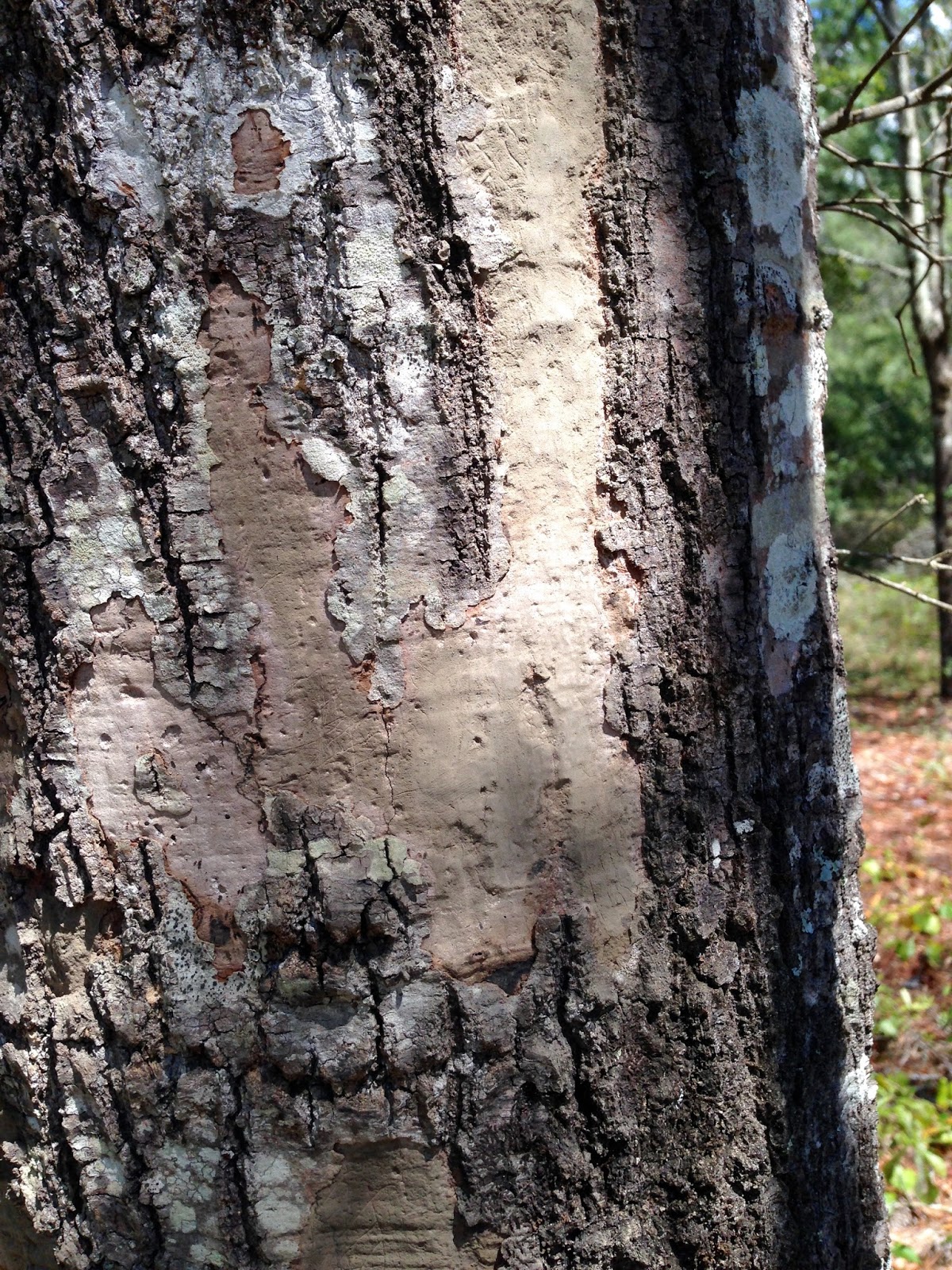
Very often when we are called to look at dead or dying oaks we find fungi in the genus Hypoxylon. These fungi are very ubiquitous and form latent colonies on healthy oaks and other hardwoods. Once the trees are weakened by stresses, such as drought, herbicide damage, insects or other diseases, Hypoxylon mobilizes to take advantage of the resources provided by a sick tree. In some cases, it may even slow the spread of more devastating diseases; trees succumbing to oak wilt are often rapidly colonized by Hypoxylon, which can use up the sugars and starch in the sapwood, preventing the oak wilt fungus from spreading.
Stromatal mat and fruiting bodies of a decaying fungus on an oak killed by flooding.

Stromatal mat on an oak killed by fungus.

Close up of stromatal mat.

Stromatal mats on willow oak that was flooded by beavers.

Stromatal mat of Hypoxylon on willow oak that has been killed by oak wilt.
 

Because Hypoxylon is so commonly found on dead and dying trees it is understandable that decline is often attributed to it. It is unlikely that Hypoxylon is ever the primary cause of mortality, but it can certainly play an important part in the decline of stressed trees. If other diseases or insects can be ruled out, conditions in the year or years prior to the onset of symptoms may be key.
Hypoxylon atropunctatum was associated with dieback and mortality of numerous oaks in the southeastern U.S. in 1981 after conditions of extreme heat and drought in 1980.

Fungi in the genus Hypoxylon are relatively easy to recognize. It decays the inner bark and sapwood so that the outer bark sloughs off, revealing the distinctive tan or gray stromatal mats. As the stromata mature they become black. Under some conditions black dome-like perithecial stromata may be formed.